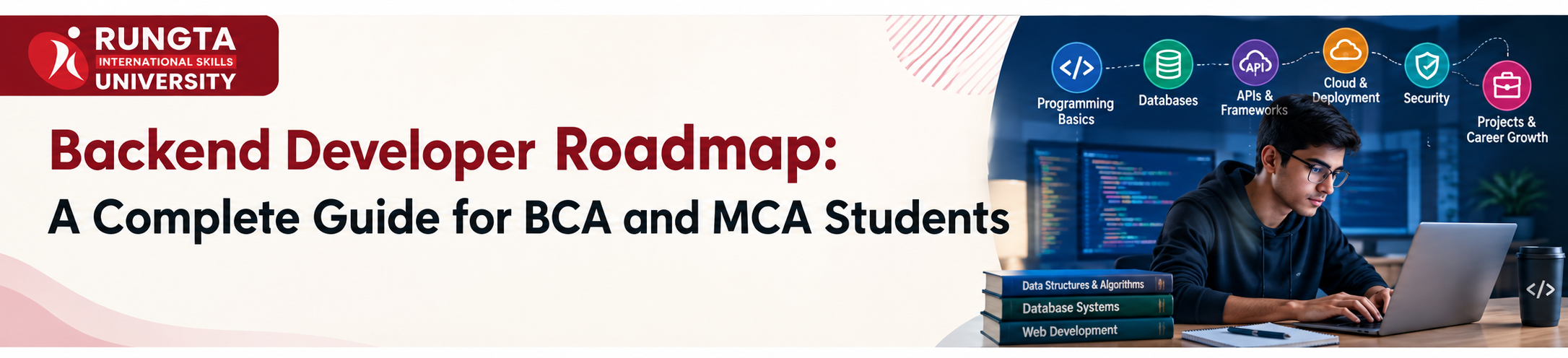
The backend developer roadmap for BCA and MCA students runs through five stages: learn programming fundamentals and one core language; master databases and version control; build REST APIs and understand authentication; learn a framework and deploy with cloud basics; then build portfolio projects that prove you can ship working systems. Entry-level backend developers in India earn ₹3–4 LPA, mid-level professionals earn ₹9–20 LPA, and senior backend engineers earn ₹15–35+ LPA, according to Glassdoor India.
What Does a Backend Developer Actually Do?
Before diving into how to become a backend developer, it helps to understand what the job involves day-to-day. When you shop online, add an item to your cart, and complete a payment, none of that happens on the screen you are looking at. A backend system calculates totals, checks inventory, processes the transaction, and updates your order status, all behind the scenes.
A backend developer builds and maintains this side of a web or mobile application. That includes managing databases, building APIs that let the frontend communicate with the server, handling authentication and security, and making sure the system stays fast and reliable as more users join.
This is different from frontend development, which handles what a user sees and clicks. Backend developers work with data, logic, and infrastructure, the parts of an application that make everything else function correctly.
Backend Developer Roadmap: Step by Step
Here is a structured backend developer learning path, built specifically for students coming from a BCA or MCA background.
Step 1: Strengthen Your Fundamentals
Start with how the internet actually works. This means understanding HTTP, DNS, the client-server model, and the request-response cycle. If you have completed a Computer Networks subject in your BCA or MCA syllabus, you already have a foundation here. Revisit it with backend development in mind, not just for exams.
Step 2: Pick One Backend Language and Get Fluent
You do not need to learn five languages. You need to be genuinely good at one. Python (with Django or Flask) is a strong starting choice because of its clean syntax and large community. Java (with Spring Boot) is widely used in Indian enterprise hiring and builds directly on what you study in your BCA or MCA curriculum. Node.js is worth learning if you want to work on real-time or event-driven systems.
Most BCA and MCA students already study Java and Python as part of their core syllabus. The roadmap here isn’t about learning a new language from scratch; it is about going from classroom-level familiarity to production-level fluency.
Step 3: Learn Git and Version Control
Every backend job expects you to know Git. Learn how to branch, merge, and handle pull requests, and host your code on GitHub. This is a basic requirement, not an advanced skill, and it should become second nature early in your learning path.
Step 4: Master Databases
Go deeper into relational databases like MySQL and PostgreSQL for structured data and transactions. Then learn a NoSQL database like MongoDB for flexible, unstructured data. Understand when to use which. A banking system needs relational integrity. A social media feed can work well with NoSQL.
Also explore caching tools like Redis, which most production backend systems use to speed up repeated queries.
Step 5: Build and Understand APIs
APIs are how your backend talks to the frontend, mobile apps, or other services. Learn RESTful API design, proper use of status codes, and API versioning. Understand authentication methods like JWT and OAuth, since almost every real application needs to verify who is making a request before responding.
Step 6: Learn a Framework
Pick a framework tied to your chosen language. Spring Boot for Java, Django or Flask for Python, or Express.js for Node.js. Go deep on one framework rather than surface-level across three. Understand its request lifecycle, middleware, and folder structure, not just how to copy a tutorial.
Step 7: Understand Security Basics
Backend systems handle sensitive data, so security cannot be an afterthought. Learn about SQL injection, cross-site scripting, and CSRF attacks, along with defensive practices like password hashing, input validation, and HTTPS. This is one of the most overlooked areas in student projects, and one that experienced interviewers specifically probe.
Step 8: Learn Basic System Design
You do not need to design systems like a senior architect on day one, but understanding concepts like load balancing, database indexing, and the difference between a monolith and microservices architecture will set you apart in interviews. This is where backend developers separate from developers who can only write CRUD operations.
Step 9: Get Comfortable with Deployment and Cloud Basics
Learn the basics of Docker for containerization and get familiar with one cloud provider, AWS, Google Cloud, or Azure. You do not need deep DevOps expertise as a fresher, but knowing how to deploy an application beyond your local machine is now a baseline expectation in most hiring processes.
Step 10: Build Backend Developer Portfolio Projects
This is the step most students underinvest in. Do not build another to-do list app. Build something with real functionality: an e-commerce backend that handles cart logic, inventory, and payment processing; a blog platform with authentication and image uploads; or a booking system with real-time availability checks. Host the code on GitHub with clear documentation, and be ready to explain every design decision in an interview.
Backend Developer Skills: The Complete Checklist
| Category | Skills to Learn |
| Programming | Java, Python, or Node.js (pick one, go deep) |
| Databases | MySQL/PostgreSQL, MongoDB, Redis |
| APIs | REST, GraphQL basics, JWT/OAuth authentication |
| Frameworks | Spring Boot, Django/Flask, or Express.js |
| Security | Input validation, HTTPS, password hashing, SQL injection prevention |
| Version Control | Git, GitHub |
| System Design | Load balancing, caching, database indexing, monolith vs. microservices |
| Deployment | Docker basics, one cloud platform (AWS/GCP/Azure) |
| Testing | Unit testing, integration testing basics |
Backend Developer Salary in India
Compensation scales meaningfully with experience and skill depth. According to Glassdoor India, entry-level backend developers earn ₹3–4 LPA. Mid-level backend engineers, per Glassdoor’s backend engineer salary data, earn ₹9–20 LPA. Senior backend engineers, according to the same source, earn ₹15–35+ LPA depending on company and specialization.
Separately, Indeed India puts the average base salary for a backend developer in India at ₹7,25,070 per year across all experience levels combined.
A few factors consistently push salaries higher: cloud and DevOps proficiency, since a large share of backend roles now expect at least basic cloud skills; experience with high-scale or data-intensive systems in fintech and SaaS; and demonstrated system design ability, not just coding output.
Career Path for Backend Developer Roles
The career path for backend developer professionals typically follows this progression:
Entry-level (0–2 years): Junior Backend Developer or Software Engineer, working on features, bug fixes, and API endpoints under supervision.
Mid-level (2–5 years): Software Engineer, API Developer, or Database Engineer, owning modules independently and mentoring junior developers.
Senior-level (5–8 years): Backend Lead or System Architect, making key technology decisions and designing subsystems for scale.
From here, many backend developers move into Full Stack Development, Solution Architecture, or DevOps and Cloud Engineering, since the foundational skills overlap significantly.
How to Learn Backend Development Through Rungta University’s BCA and MCA Programs
If you are wondering how to learn backend development in a structured way rather than piecing it together from scattered tutorials, your degree programme matters more than most students realise. The School of IT at Rungta University offers programs specifically designed to build this roadmap into the curriculum rather than leaving it to self-study.
BCA in Full Stack Development, in association with Google is the most directly relevant undergraduate option. It covers backend fundamentals including databases, server-side programming, and API development from the third year onward, alongside frontend skills. Students graduate with certifications from Google, IBM, Microsoft, Amazon, and NVIDIA built into the programme, and get access to cloud platforms including Google Cloud, AWS, and Azure through university labs.
MCA in Full Stack Development, in association with Google is the stronger route for students who already hold an undergraduate degree and want to specialise faster. The two-year postgraduate structure moves quickly into advanced backend topics, including microservices, system design, and deployment, with live projects mentored by industry professionals.
BCA & MCA (Integrated) Full Stack, in association with Google, suits students entering directly after 10+2 who already know they want to build deep backend and full-stack expertise. This 5-year programme compresses the undergraduate-to-postgraduate journey without the usual gap year, keeping momentum through the entire roadmap outlined above.
Across all three programmes, students get access to Rungta’s coding ecosystem, which runs competitive programming clubs and hackathon participation, including Smart India Hackathon, giving students the applied practice this roadmap depends on. Programmes feed into the Rungta University placement pipeline, which recorded 2,500+ placements in 2025 across 250+ recruiters including Microsoft, Amazon, TCS, Deloitte, and Capgemini, with a highest package of ₹38 LPA.
FAQs
How long does it take to become a backend developer from a BCA or MCA background?
With focused effort, most BCA students can reach an entry-level backend role within 6 to 12 months of dedicated practice on top of their coursework, particularly if they build 2 to 3 solid portfolio projects. MCA students, given the deeper coursework and additional year, often move faster into mid-level readiness.
Which backend developer skills should I prioritize first as a student?
Prioritize one programming language, SQL and database design, and basic API development before anything else. These three areas cover the majority of what entry-level interviews test. Cloud and system design matter, but they build on top of this foundation, not before it.
Are backend developer portfolio projects more important than my degree GPA?
For most technical hiring, yes. A well-documented project with working authentication, a real database schema, and deployed functionality demonstrates more to a recruiter than a percentage on a transcript. That said, a strong academic record combined with strong projects gives you the most competitive profile.
Is backend development a good career path for BCA students, or should I aim for full stack instead?
Both are valid, and the skills overlap significantly. Backend specialisation suits students who enjoy system logic, databases, and architecture. Full stack suits students who want versatility across both user-facing and server-side work. Many backend developers add frontend skills over time regardless of their starting specialisation.
Do I need to learn DevOps to become a backend developer?
Not immediately, but basic familiarity with Docker and one cloud platform is increasingly expected even at entry level. You do not need deep DevOps expertise as a fresher, but avoiding cloud and deployment concepts entirely will limit your interview readiness.