
Journal CSIT
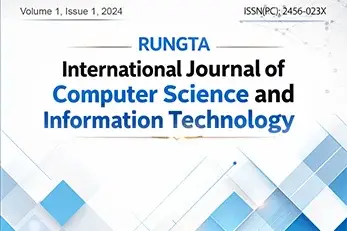
Publisher: Rungta International Skills University
Issue(s) Available: 2
ISSN Number: 2456-026X(O)
Indexed: i-scholar, UGC, Google Scholar, Research Gate
Frequency:- Biannual (June & December)
Issue(s) Available: 2
ISSN Number: 2456-026X(O)
Indexed: i-scholar, UGC, Google Scholar, Research Gate
Frequency:- Biannual (June & December)
Journal Information
Rungta International Journal Computer Science and Information Technology that embraces a broad range of fields within the discipline and renders a common platform for the researchers engaged and practitioners of ethical and legal issues. This scholarly publishing journal follows a rapid peer review process for each submission to attain better quality. Original research articles, reviews and short communications in the area of computer science and information technology are most welcome for publication. The journal process articles through Editorial Manager System for quality maintenance. Review process is executed by the editorial board members of Journal of or by outside experts. The RIJCSIT is published biannual in June & December.
Topics of interest include but are not limited to, the following
-
Ad-Hoc, Mobile, Wireless Networks and Mobile
Computing - Algorithms and Bioinformatics
- CDMA/GSM Communication Protocol
- Computer Architecture and Real time Systems
- Database and Data Mining
- DSP/Image Processing/Pattern Recognition/Multimedia
- E-Business Applications
- Embedded system and software
- Grid and scalable computing
- Intelligent Information & Database Systems
- IT policy and business management
Editorial Team
Editor in chief :
- Dr. Ram Krishna Rathore
Professor, Rungta college of Engineering and Technology,RU - Dr Manish Manoria
Professor, Rungta college of Engineering and Technology, RU
Editorial Board
- Dr. Padmavati Shrivastava
Professor, Rungta college of Engineering and Technology,RU - Dr Sanjeev Shukla
Professor, Rungta college of Engineering and Technology, RU - Dr. Ajay Kushwaha
Professor, Rungta college of Engineering and Technology,RU - Dr. Anurag Sharma
Professor, Rungta college of Engineering and Technology, RU - Dr. Huma Khan
Professor, Rungta college of Engineering and Technology,RU - Dr Tripti sharma
Professor, Rungta college of Engineering and Technology, RU - Dr Subhash C. Shrivastava
Professor, Rungta college of Engineering and Technology, RU - Dr Bhupesh Kumar Dewangan
Associate Professor, Symbiosis Nagpur - Dr Anupam Shukla
Director, SVNIT, SURAT - Dr Kapil Nagwanshi
Associate Professor, GGU Bilaspur
Guidelines for Authors & Reviewers
Guidelines for Authors & Reviewers
RIJES guides you for writing a research paper starting from inception of ideas till their publications. Research papers are highly recognized in scholar fraternity. In addition, the published research work also provides a big weight-age to career growth and helps to get admission in reputed varsity. Now, here we enlist the proven steps to publish the research paper in a journal. Essentially a research paper consists of five major sections. The number of pages may vary depending upon the topic of research work but generally comprises up to 6 to 10 pages.
These are:
1. Abstract
2. Introduction
3. Research Elaborations
4. Results or Finding
5. Conclusions
6. References
1. Abstract:
An abstract is a brief summary of a research article, thesis, review, conference proceeding or any in-depth analysis of a particular subject or discipline, and is often used to help the reader quickly ascertain the paper’s purpose. When used, an abstract always appears at the beginning of a manuscript, acting as the point-of-entry for any given scientific paper or patent application.
2. Introduction:
It’s the foremost preliminary step for proceeding with any research work writing. While doing this go through a complete thought process of your Journal subject and research for its viability by following means:
Read already published work in the same field
Goggling on the topic of your research work
Attend conferences, workshops and symposiums on the same fields or on related counterparts. Understand the scientific terms and jargon related to your research work.
3. Research Elaborations:
Now it is the time to articulate the research work with ideas gathered in above steps by adopting any of below suitable approaches:
Bits and Pieces together: In this approach combine all your researched information in form of a journal or research paper. In this researcher can take the reference of already accomplished work as a starting building block of its paper. Jump Start: This approach works the best in guidance of fellow researchers. In this the authors continuously receives or asks inputs from their fellows. It enriches the information pool of your paper with expert comments or up gradations. And the researcher feels confident about their work and takes a jump to start the paper writing.
Use of Simulation software: There are numbers of software available which can mimic the process involved in your research work and can produce the possible result. One of such type of software is MATLAB(R). You can readily find Mfiles related to your research work on internet or in some cases these can require few modifications. Once these Mfiles are uploaded in software, you can get the simulated results of your paper and it easies the process of paper writing.
4. Results or Finding:
This section also has more details about your research in continuation with above section.
5. Conclusions:
This section will have conclusions about your research.
6. References:
References must be given in IEEE format.
As by adopting the above practices all major constructs of a research paper can be written and together compiled to form a complete research ready for Peer review.
For peer review you can send research paper in IEEE Format to us at: crc@rungta.ac.in
Pricing Info
Subscription Charges
| Category | India | Foreign | ||
|---|---|---|---|---|
| Print + Online | Print + Online | |||
| Institutional / Corporate | Rs. 2700 | Rs. 3500 | USD 150 | USD 180 |
| Individual / Students | Rs. 2700 | Rs. 3500 | USD 150 | USD 180 |
Peer Review & Publication Policy and Ethics Policy
Peer Review Policy
- Rapid Peer Review: The journal follows a rapid peer review process to ensure timely evaluation of submissions.
- Double-Blind Review: Both authors and reviewers remain anonymous to maintain fairness and objectivity.
- Editorial Oversight: Manuscripts are first screened by the editorial team for scope, originality, and ethical compliance before being sent to reviewers.
- Reviewer Criteria: Reviewers assess manuscripts based on novelty, methodological rigor, clarity of presentation, and contribution to the field of computer science and information technology.
- Decision Outcomes: Possible outcomes include acceptance, minor revision, major revision, or rejection. Authors are notified with detailed reviewer comments to guide improvements.
- Decision Outcomes: Possible outcomes include acceptance, minor revision, major revision, or rejection. Authors are notified with detailed reviewer comments to guide improvements.
Publication Policy
- Types of Articles: The journal accepts original research articles, review papers, and short communications.
- Frequency: It is a annual journal (one issues per year).
- Submission System: Manuscripts are processed through the Editorial Manager System to maintain quality and transparency.
- Ethics Compliance: Authors must adhere to ethical guidelines, including originality, avoidance of plagiarism, and proper citation of sources.
- Open Access & Indexing: The journal is indexed in i-Scholar and provides access to published issues online.
- Publisher: Rungta Group of Colleges.