Choosing a career in computer applications has become a carefully planned decision for students entering higher education today. Business processes, governance, education, and service management in industries are now driven by digital systems.
The Bachelor of Computer Applications program provides students with a preliminary and organised access to this technology-powered ecosystem. It integrates the principles of computing with real-world learning, enabling students to learn how digital tools are applied in the real world. As awareness increases, students now evaluate BCA colleges in India based on academic strength, infrastructure quality, faculty support, and long-term career guidance before finalising their choice.
Understanding the Demand for BCA in the Digital India Era
The digital transformation in India has altered labour requirements in nearly all industries. Banking services, educational facilities, health facilities, logistics systems, and administration are now run by software-based systems. This growth has made the demand for computer training professionals very high.
BCA programs satisfy this need by emphasising practical concepts of computing. At the undergraduate level, students are taught programming, database management and application development. This will equip them with an entry-level technical position in an early part of their career.
Why BCA Remains Relevant in Today’s Job Market
The relevance of BCA continues to grow due to sustained digital adoption. Organisations now need professionals who are familiar with systems, applications and simple processes of development.
The major forces causing demand in BCA are:
- Spreading IT-enabled services in the conventional industries.
- Greater reliance on software applications to conduct their daily activities.
- Increasing demand of system support and applications maintenance specialists.
Students comparing BCA colleges in India increasingly prioritise programs that emphasise applied learning over purely theoretical instruction. The given change throws light on the significance of formal BCA training in the present context.
What Makes a BCA College Truly Stand Out?
Not every institution that provides BCA programs provides the same academic results. Quality education cannot be described only by the curriculum structure. The way of teaching, the faculty contribution and the exposure of the students to real life contribute greatly to the preparedness of the students.
Strong BCA colleges focus on conceptual clarity before moving to applications. Hands-on lessons complement the classroom lessons and enable students to become more confident. Constant learning assistance is also significant.
Core Academic Elements That Define Strong BCA Colleges
A good BCA institution usually achieves consistency in academics and competency development during the course.
Key attributes include:
- Upgraded curriculum to conform to computing basics.
- Frequent sessions in the laboratory to aid practical work.
- Academic and professional advising of the faculty.
Among BCA colleges in India, institutions that integrate structured academics with mentoring create better learning outcomes. Practice is known to build greater technical confidence in students.
A Closer Look at Rungta University’s Approach to BCA Education
Rungta University is a progressive and systematic approach towards BCA. The program is to be developed in such a way as to create solid underpinnings before moving on to sophisticated application concepts. Every academic stage facilitates the gradual acquisition of skills.
The university highly emphasises theoretical knowledge and real-world experience. Learners are taught the logic, management of data and fundamentals of the systems in a systematic manner. This will alleviate learning and academic confidence.
How the BCA Program Is Structured at Rungta University
The educational structure guarantees that students do not feel overwhelmed but their level of learning is not compromised.
Key focus areas include:
- Semester-to-semester learning of foundation-to-application.
- Theoretical teaching with lab work.
- Ongoing academic checking and assessments.
This structured approach places Rungta University among emerging BCA colleges in India offering career-oriented undergraduate computing education.
Infrastructure That Supports Practical Learning
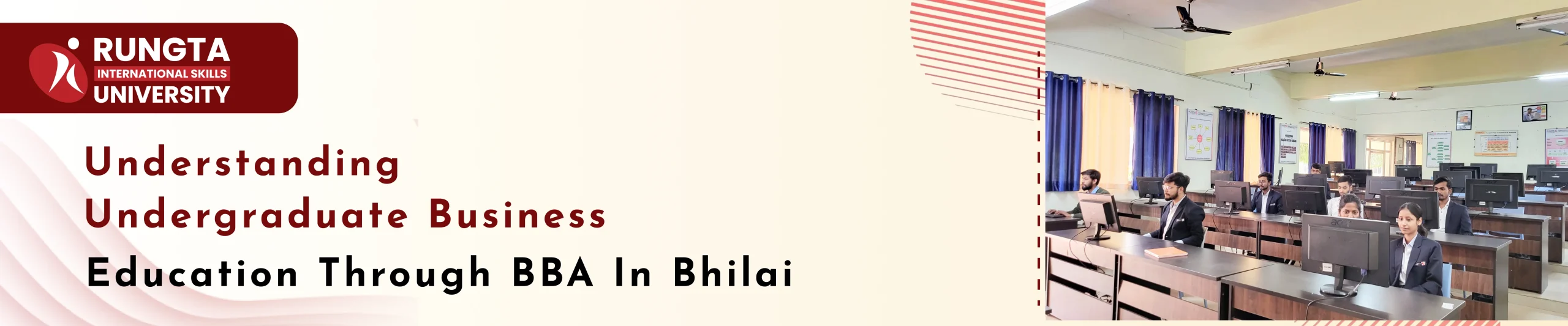
Effective practical learning depends on reliable and accessible infrastructure. Rungta University provides dedicated computing facilities designed specifically for BCA students. These facilities support regular hands-on learning.
Lab sessions have students working on exercises and applications that need programming. This improves problem-solving capacity and builds on sound reasoning. The hands-on exposure is also maintained during the studies program.
Learning Facilities Designed for Skill Development
The infrastructure has a direct impact on skill-building.
The major infrastructure strengths are:
- Specialized computer lab schools of BCA programs.
- Software environments aligned with curriculum requirements
- Laboratory classes blended with classroom learning.
Compared to many BCA colleges in India, Rungta University ensures that practical learning remains central to its education delivery model.
Faculty Mentorship & Academic Support System
Mentorship among the faculty is an important part of undergraduate education. Rungta University focuses on individualised academic instruction and classroom learning. The faculty members are also involved in giving support to the students during their academic lifecycle.
Consistent discussions can be used to elucidate ideas at the initial stages. The students are advised on assignments, work, and exams. This lowers the academic stress and enhances the learning results.
Student-Centric Academic Support Framework
The academic supportive environment is managed in a way that promotes consistency and confidence.
Key elements include:
- Accessible faculty for doubt clarification and guidance
- Mentorship-based learning style.
- Constant academic feedback systems.
This kind of support empowers student participation and self-esteem. It clearly differentiates Rungta University among student-focused BCA colleges in India.
Industry Exposure & Career-Oriented Training
Exposure to the industry facilitates the gap between academia and employment. Rungta University incorporates career-oriented aspects in its BCA program. Students become aware of professional expectations at an early stage.
The areas of training include skills in the technical field, discipline at work, and communication skills. Academic learning gradually goes hand in hand with the professional preparation of students. This equips them with internships and low-level jobs.
Career Preparation Embedded in Academic Learning
The process of career readiness is developed over time and is not a last-minute endeavour.
Key initiatives include:
- Skill development sessions aligned with industry needs
- Experience in the application contexts of projects.
- Academic practices in favour of employability preparedness.
Among BCA colleges in India, institutions offering structured career exposure significantly improve graduate adaptability.
Career Opportunities After Completing BCA
BCA graduates can have various employment opportunities in the field of IT, software and postgraduates. Rungta University trains students in professional and higher-level studies.
Technical and Software Positions.
Students are allowed to work in development and application support.
- Software developer/ programmer: Writing/ testing application code.
- Web / App Developer: Web and mobile app development.
- Software Tester / QA Analyst: Verifying software.
IT Support and System Administration.
The graduates are able to handle the systems and networks of the company.
- System Administrator: The management of servers and networks.
- Database Administrator: Administration and protection of databases.
- Technical Support Executive: Helping users with IT-related problems.
Higher Studies and Specialization
Other students are pursuing higher education to improve career development.
- MCA (Master of Computer Applications): Enhances knowledge on software and systems.
- Certification Courses: AI, cloud computing or cybersecurity training in the short term.
This brief outline means that the BCA students at the Rungta University are prepared to work in practice and advanced schooling. Among BCA colleges in India, it stands out for career-oriented preparation.
Why Students Prefer Studying BCA in a Growing Education Hub Like Chhattisgarh
New centres of learning offer specialised learning facilities. With less urban distraction, Chhattisgarh has affordable education. Academic ecosystems are beneficial to the students.
Rungta University is a good example of capitalising on this strength. The school climate encourages learning and group work. Students are more involved with learning objectives.
Advantages of Studying in a Growing Education Region
Such regions offer balanced academic experiences.
Key advantages include:
- Affordable educational services.
- Improved student-faculty intercourse.
- Intense and rigorous learning programs.
As students compare BCA colleges in India, growing education hubs are gaining strong preference for undergraduate studies.
Conclusion
Selecting a BCA college can be considered as the determining factor in the career of a student. Academics, infrastructure, mentorship, and career exposure are more powerful institutions that provide better results.
Rungta University is in the process of reinforcing its BCA framework with the help of systematic learning and student-centred support. With its emphasis on practical education, academic consistency, and career readiness, the university is steadily emerging among promising BCA colleges in India for students seeking a strong foundation in computer applications.
FAQs
- Is BCA a good career option in India?
Yes, BCA offers strong opportunities in IT, software development, and digital services.
- What is the duration of the BCA course?
The BCA program typically spans three years, divided into six semesters.
- What makes a university ideal for studying BCA?
Strong academics, practical labs, experienced faculty, and career support are essential.
- Can students from non-math background apply for BCA?
Yes, some universities allow non-math students, but eligibility may vary.
- What kind of jobs can students get after BCA?
Graduates can work as software developers, system administrators, web/app developers, or pursue higher studies.